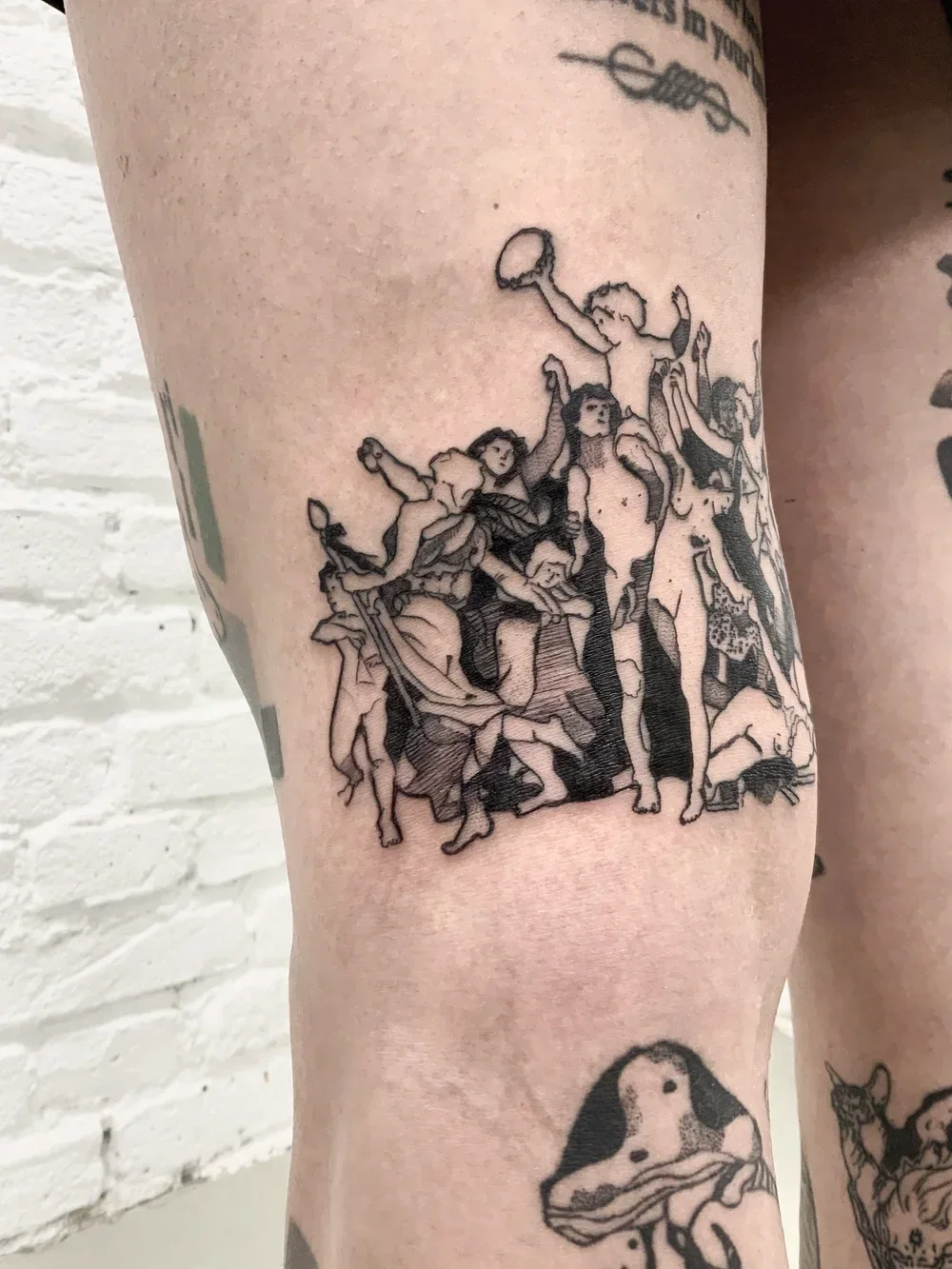
“Bacchus and a Divine March” — after La Jeunesse de Bacchus
@notattoo_berlin · @visionsofecstasy.studio
Tattooed for @etions_formidables
This tattoo comes from La Jeunesse de Bacchus — not as a copied fragment, but as a movement taken from the painting.
What matters here is not one isolated figure. It is the procession itself. A group of bodies moving together, almost like a single organism. A march that seems to continue beyond the limits of the image.
Painted in 1884 by William-Adolphe Bouguereau, La Jeunesse de Bacchus is a work built through rhythm, scale, and controlled excess. Bacchus appears young, but not innocent in a simple way. He is suspended between youth and something older, wilder, and already inevitable.
He does not stand like a monument. He moves. He leads.
Around him, the figures create a collective force: nymphs, satyrs, dancers, musicians, bodies turned toward the same pulse. There are no real spectators inside the image. Everyone seems absorbed by the same direction, the same rhythm, the same temporary loss of individual control.
Bouguereau’s painting is precise, almost impossibly controlled, but the subject itself is unstable. Order is there, but it is holding something that wants to escape. The composition is disciplined, while the procession suggests pleasure, exhaustion, ritual, and surrender.
This tension was the reason the image became interesting as a tattoo. It was not about reproducing a classical painting as decoration. It was about taking one part of that movement and allowing it to live on the body.
The tattoo was placed on the back of the knee — a difficult area, intense, sensitive, and unforgiving. The placement felt right. The body bends there. It moves there. It does not allow the image to remain completely still.
Like the procession in the painting, the tattoo asks for endurance. It follows movement. It changes with the position of the leg. It belongs to a part of the body where tension, pressure, and motion are always present.
This is not a myth frozen in time. It is a small piece of a larger march: bodies moving together, structure losing control, rhythm becoming stronger than reason.
A reminder of something deeply human — the need to step outside order, even briefly, and follow a pulse without knowing exactly where it leads.
The procession is still moving.
And the march goes on.
nOT
“Bacchus and a Divine March” — after La Jeunesse de Bacchus
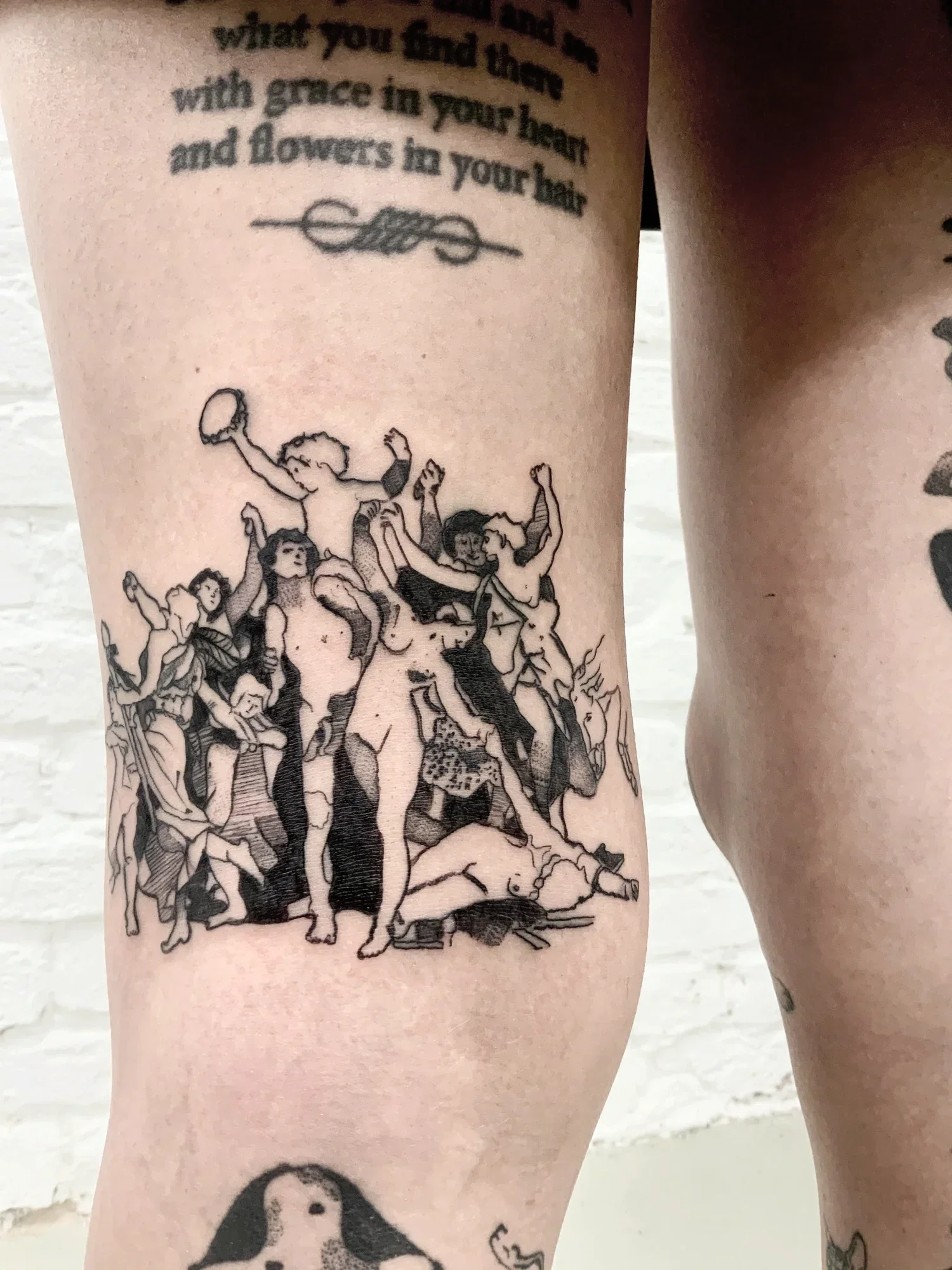
@notattoo_berlin tattoo done in @visionsofexctasy Studio