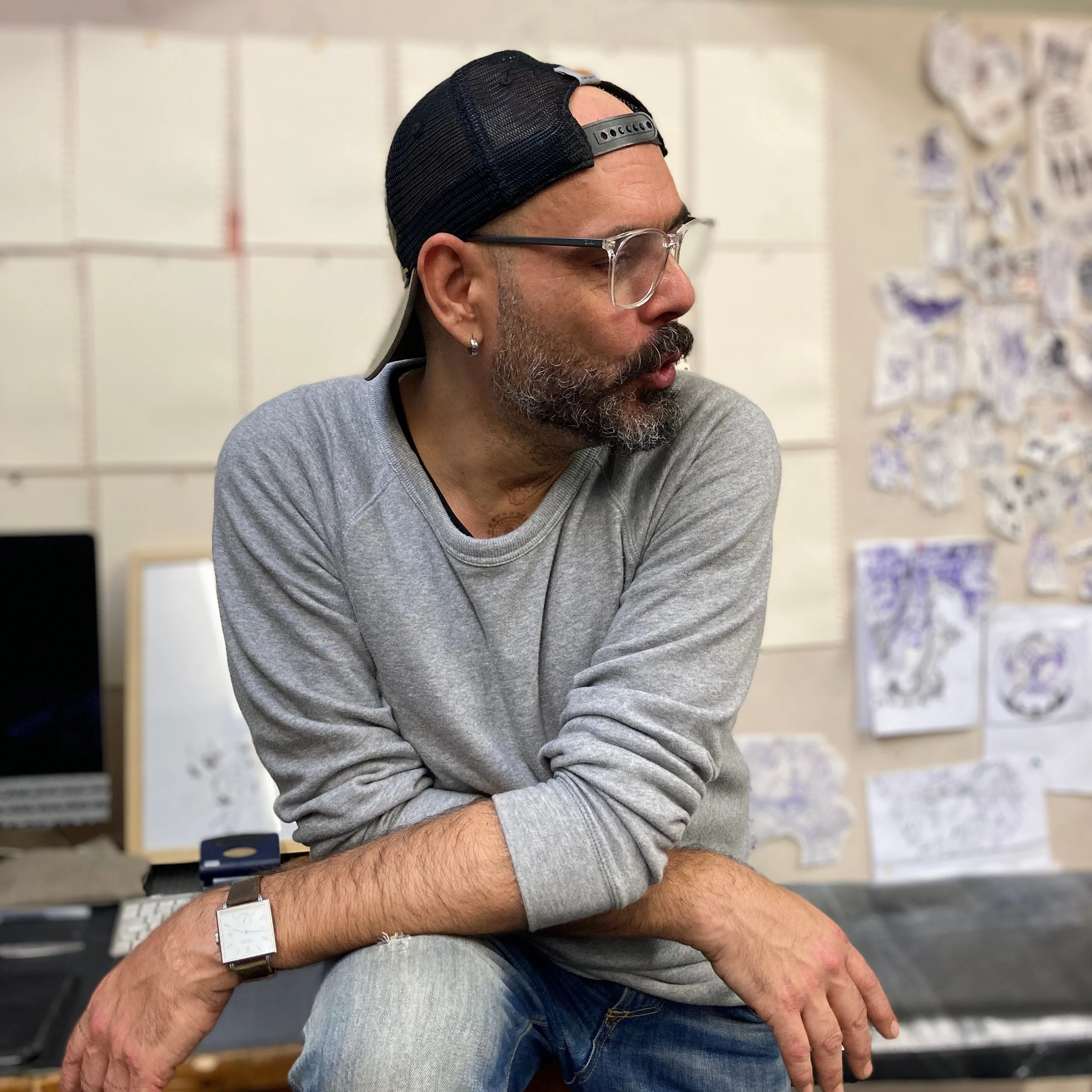
jorgedacruz is a Lisbon-born artist based in Berlin since 2011. His work moves between large-scale charcoal drawing, contemporary tattooing, and image-based projects that explore memory, classical references, material tension, and the relationship between body, surface, and image.

Drawing is central to his work. Often made with charcoal, chalk, and strong black-and-white contrasts, his compositions are built slowly through layers, erasure, pressure, and repetition. The process is physical and contemplative, creating images that resist immediate reading and invite a slower form of attention.

His visual language draws from art history, Mediterranean culture, classical forms, religious imagery, everyday life, and contemporary urban experience. Rather than following a single narrative, the works often create spaces of tension between presence and absence, structure and collapse, detail and emptiness.

Educated at Ar.Co — Centro de Arte e Comunicação Visual in Lisbon, jorgedacruz began his artistic path through painting, pastel, and drawing before developing the stark charcoal language that defines much of his current work. Large formats, fragmented landscapes, architectural memory, and empty spaces remain central to this practice. The gaps in the image are as important as the marks themselves, leaving space for the viewer to complete what is not fully shown.

Tattooing developed later as a parallel extension of the same visual world. Rather than treating tattooing as separate from drawing, jorgedacruz approaches skin as another surface where line, contrast, composition, and personal meaning can exist. His tattoo work combines fine lines, strong black contrasts, solid black areas, classical references, and rougher visual tensions connected to contemporary and ignorant tattoo aesthetics.

Custom tattoos are an important part of his work. Many of the tattoos he values most began from ideas, memories, or references brought by clients and developed through dialogue, exchanged references, and drawing together. This collaborative process allows each image to become more personal, layered, and connected to the person wearing it.

Across paper, skin, and other surfaces, jorgedacruz’s work remains connected by the same questions: how images carry memory, how forms survive through transformation, and how drawing can create a space between what is visible and what is missing.

Berna Valada

JorgedaCruz
Why noSHBerlin Exists

noSHBerlin is a Berlin-based clothing label developed through the artistic and tattoo practice of jorgedacruz. The project emerged from a simple idea: if an image can exist as a drawing, a tattoo, or an artwork, why couldn't it also exist as an object designed for everyday use?

Rather than approaching clothing as merchandise, noSHBerlin treats it as another medium. Images move between paper, skin, embroidery, and fabric, allowing the same visual language to exist in different forms and contexts. A drawing can become a tattoo. A tattoo can become a hoodie. A hoodie can become part of someone's daily life.

The project is rooted in drawing, tattoo culture, classical imagery, and contemporary urban life. It is influenced by the belief that everyday objects can carry the same attention, meaning, and personality often associated with artworks.

The relationship between center and periphery is central to the identity of noSHBerlin. The project is shaped by a suburban perspective and by the experience of moving between different forms of belonging, distance, and participation. Center and periphery are understood not only as geographical realities, but also as cultural and social positions that continue to influence how identities, aesthetics, and visual languages are formed.

noSHBerlin exists somewhere between an art project and a clothing label. It is a shop, but it does not want to feel like a traditional shop. The intention is not to produce endless collections or follow seasonal cycles, but to create pieces that feel personal, durable, and connected to the ideas from which they emerged.

Quality matters more than quantity. Most releases are produced in very small quantities and without restocks, maintaining a closer relationship between the image, the object, and the person who chooses to wear it.

At its core, noSHBerlin is simply another way for drawings, references, and ideas to exist in the world — not as products alone, but as everyday objects shaped by use, memory, and time.

Why Limited Editions

Limited editions are central to noSHBerlin because the project comes from tattooing.

A tattoo is made once. It belongs to one person, one body, one moment, and one story. Even when the same reference or image appears again, the final result is never exactly the same. It is shaped by the client, the placement, the conversation, the drawing, and the decision to make something permanent.

noSHBerlin follows that same logic. Most pieces are produced in very small quantities, often only one piece per size, and are not restocked. This is not only a production choice. It is part of the identity of the project.

The idea is simple: a piece should feel personal. When someone chooses a hoodie, a t-shirt, or another object from noSHBerlin, it should not feel like something endlessly available everywhere. It should feel closer to finding a drawing, choosing a tattoo, or carrying an image that has a specific origin and a specific life.

Many of the images used in noSHBerlin come from tattoo drawings, art historical references, or visual ideas developed through the work of jorgedacruz and noTATTOO Berlin. Some were first created for skin. Others come from the same visual universe: charcoal drawing, tattoo culture, classical imagery, urban observation, and the tension between center and periphery. When these images move into clothing, they keep part of that original charge.

The limited edition approach protects that connection. It allows the image to remain specific instead of becoming a repeated graphic detached from its origin. A drawing that was once connected to the body, to a client, or to a particular reference should not become something multiplied without care.

noSHBerlin is not interested in mass production. The project does not imagine piles of identical hoodies in a physical shop or endless stock made to fill a market. The pieces exist in small numbers, mainly online, and in the future possibly in selected tattoo studio contexts — places where the connection between drawing, body, clothing, and tattoo culture still makes sense.

This also changes the relationship between the person and the object. The person wearing the piece knows that it will not be everywhere. They will probably not cross another person wearing the same hoodie or the same image. That creates a quieter form of exclusivity, without luxury language or artificial status. It is simply about keeping the object close to the idea from which it came.

Quality matters more than quantity. Each release is treated as something that should age well, be worn repeatedly, and keep its own personality over time. The goal is not to create seasonal fashion, but everyday pieces with a strong visual identity and a limited presence in the world.

Like tattoos, these pieces are not meant to exist forever as stock. They appear, they are chosen, and then they disappear.

That disappearance is part of their meaning.

Tattoo Culture and Clothing

noSHBerlin exists because tattooing and clothing share a direct relationship with the body.

A tattoo is not only an image. It is an image placed on skin, shaped by movement, memory, time, and personal decision. Clothing also lives close to the body. It moves with the person wearing it, becomes part of daily gestures, and slowly absorbs traces of use. This connection between skin and fabric is central to noSHBerlin.

The project comes from a contemporary tattoo culture that is different from the old traditional tattoo scene. Over the last decade, tattooing has changed deeply. Machines became more accessible, images circulated faster through social networks, and many people entered tattooing from other creative fields such as drawing, graphic design, fashion, photography, illustration, and contemporary art.

This shift opened space for new voices outside the usual structures of closed studios, traditional apprenticeships, and established visual codes. A new generation began working from more informal, experimental, and self-taught positions. Some tattooed friends at home. Some developed small personal practices. Some later entered studios. From this movement came a different energy: more direct, more fragile, sometimes rougher, sometimes more intimate.

This is the world where jorgedacruz found his place in tattooing. Not through a traditional path, but through drawing, experimentation, and the alternative tattoo scene in Berlin. His tattoo work is connected to contemporary and ignorant tattoo aesthetics, while also drawing from art history, classical imagery, Mediterranean culture, and the physical language of charcoal drawing.

For noSHBerlin, this background matters. Clothing is not treated as merchandise or as a decorative extension of tattooing. It is another surface where images can exist. Before an image becomes a tattoo, an embroidery, a hoodie, or a t-shirt, it begins as a drawing — a line, a reference, a distortion, or a fragment taken from art history, tattoo culture, or everyday urban life.

A tattoo artist makes clothing because the image does not need to remain fixed to one medium. The same visual language can move from paper to skin, from skin to fabric, from a private tattoo appointment to an everyday object worn in the city. noSHBerlin follows this movement without separating artwork, tattooing, and clothing into isolated worlds.

Tattooing carries a strong idea of permanence. Once a tattoo is made, it stays with the body and changes with time. Clothing is different, but it also creates a relationship with duration. A hoodie can be worn repeatedly, faded, repaired, stretched, remembered, and connected to a specific period of life. It is not permanent in the same way as a tattoo, but it can still become personal.

This is why noSHBerlin is interested in everyday use. The project is not built around fashion as performance or clothing made only for display. It is interested in pieces that become familiar through repetition. An image becomes stronger when it leaves the screen, the sketchbook, or the studio and enters daily life.

The connection to tattoo culture is also visible in the way the pieces are produced. Many releases are limited, often only one piece per size, with no restocks. This follows the logic of tattooing: an image should feel specific, personal, and connected to the person who chooses it. It should not become endlessly repeated or detached from its origin.

The relationship between tattooing and clothing is emotional and physical. Both involve trust, proximity, identity, and the decision to carry an image close to the body. Both can mark a period of life. Both can become part of how someone presents themselves to the world.

At its core, noSHBerlin understands clothing as an extension of contemporary tattoo culture: personal, image-based, body-related, and shaped by time.

Distance Between Center and Periphery

The distance between center and periphery is one of the central ideas behind noSHBerlin.

This distance is not only geographical. It is also emotional, social, cultural, and psychological. It describes the space between where identities are formed and where they are later recognized, between the places people come from and the places they try to reach.

noSHBerlin is shaped by suburban memory. It comes from the experience of growing up outside the center, in a place close enough to feel connected to the city, but far enough to feel separated from it. The periphery is often treated as secondary, unfinished, or waiting to become something else. But it is also where many visual languages, habits, frustrations, and forms of identity begin.

These spaces are never empty. Long commutes, crowded buses, unfinished buildings, shopping centers, parking lots, temporary structures, and the daily movement toward the center all create a particular way of seeing. They produce sensitivity to distance, waiting, observation, and desire.

Later, life in central Berlin changed the position but not the memory. The project comes from the strange condition of being a peripheral person inside the center: close to cultural life, but still shaped by the experience of distance. The center becomes something inhabited, while the periphery remains something remembered, observed, and partly imagined.

This tension is important to noSHBerlin. The project does not treat Berlin as a polished image or a lifestyle background. It is more interested in the unfinished city: construction sites after rain, empty mornings after long nights, underground stations, temporary spaces, industrial edges, club culture, and the everyday movement between visibility and disappearance.

The center often presents itself as the place where culture happens. But many things arrive there already formed elsewhere. Styles, gestures, images, and identities often begin at the edges, in places with less visibility and fewer official narratives. The periphery produces its own intelligence, even when it is not immediately recognized.

Writers such as Georges Perec paid attention to ordinary spaces and the quiet structures of daily life. That kind of attention is close to the way noSHBerlin looks at the city: not through monuments or obvious symbols, but through fragments, routines, surfaces, and overlooked places.

For noSHBerlin, center and periphery are not only themes. They are positions. They shape how images are chosen, how clothing is imagined, and how identity is understood. The project does not come from the fantasy of belonging completely to the center, but from the tension of being close to it while carrying another geography inside.

In this sense, noSHBerlin is not simply a Berlin-based clothing label. It is a project about movement, memory, and the spaces between belonging and observation.

It is not only fashion.

It is identity.

Berlin Suburban Influence

noSHBerlin is shaped by suburban memory.

This memory is not only individual. It belongs to a wider experience of growing up outside the center, close enough to feel the city, but far enough to understand distance as part of daily life. It comes from places like São João da Talha, a suburb of Lisbon shaped by industrial work, commuting, and the slow arrival of infrastructure.

During the 1980s and 1990s, many suburban areas around Lisbon were still being formed. Roads, schools, buildings, shops, and transport connections appeared gradually, while everyday life was already happening around them. These places were not empty or passive. They were working, adapting, and creating their own forms of centrality.

São João da Talha was connected to the industrial life along the Tejo River, where many factory workers and their families lived. This created a practical and transitional landscape, marked by work, movement, waiting, and distance.

Commuting was central to that experience. Going to school, going to Lisbon, waiting for buses, crossing traffic, and moving toward the center created a specific relationship with the city. The center was close enough to shape desire, but far enough to remain something that had to be reached.

Around Expo 98, Lisbon’s eastern riverfront and transport connections changed deeply. Distances became smaller, and areas that once felt peripheral became more connected. But the memory of that earlier separation remained, not as nostalgia, but as a way of seeing.

This is important for noSHBerlin because the project does not look at the city only from the center. It carries attention to unfinished spaces, temporary structures, ordinary materials, practical clothing, local habits, and places that are often considered secondary.

Berlin enters this memory from another angle. The city is central, but it is also full of unfinished edges: construction sites after rain, empty mornings after long nights, underground stations, industrial zones, temporary spaces, club exits, and streets that feel unresolved even inside the center.

That is why noSHBerlin is not interested in a polished image of Berlin. The project is closer to the everyday city: clothes worn while moving through it, images carried on the body, drawings shaped by memory, and objects connected to ordinary routines rather than special occasions.

Suburban influence is not nostalgia. It is a form of attention. It comes from knowing that culture is not only created in visible centers, but also in places of transition, work, waiting, and distance.

In noSHBerlin, this memory becomes part of the clothing. The pieces are everyday objects with their own personality: limited, durable, image-based, and connected to drawing, tattoo culture, and contemporary urban life.

A hoodie is not only a hoodie. It can carry an image, a reference, a memory, and a position.

For noSHBerlin, suburban influence means looking at Berlin while remembering other outskirts. It means understanding the center from within, without forgetting the distance that formed the eye.

From Tattoo to Fabric

noSHBerlin begins with images that often come from tattooing.

A tattoo drawing is created with the body in mind. It has to consider placement, movement, scale, skin, distance, and the way an image will age over time. It is never only a drawing on paper. From the beginning, it already imagines another surface.

Moving from tattoo to fabric does not mean simply copying an image onto clothing. It means translating it. A line made for skin behaves differently when it becomes embroidery. A shape that works on the body changes when it is placed on a hoodie or a t-shirt. The image has to be reconsidered through thread, texture, weight, color, and everyday use.

This translation is central to noSHBerlin. The project follows the movement of an image from drawing to tattoo, from tattoo to embroidery, from embroidery to clothing, and finally into daily life. Each step changes the image, but also keeps something from its origin.

Some images used in noSHBerlin were first made for tattoos. Others come from the same visual world: charcoal drawing, medieval references, classical imagery, religious painting, contemporary tattoo culture, and urban observation. When they move into fabric, they do not become merchandise. They become another version of the same work.

Embroidery is important because it gives the image a physical presence. It is slower, more tactile, and more permanent than a flat print. The thread sits on the surface. It casts small shadows. It changes with light. It allows the drawing to become part of the object, not just something placed on top of it.

This is why the process matters. A hoodie is not treated as a neutral support. It becomes a surface with its own conditions, just like skin or paper. The weight of the fabric, the color of the piece, the size of the embroidery, and the position of the image all affect how the work is experienced.

The movement from tattoo to fabric also changes the relationship between image and body. A tattoo stays permanently on skin. A hoodie can be worn, removed, folded, washed, damaged, kept, or passed on. It is less permanent, but still intimate. It lives close to the body and becomes part of ordinary gestures.

For noSHBerlin, this is where the project becomes interesting: when an image leaves the studio and begins to be used. A drawing can become a tattoo. A tattoo can become embroidery. Embroidery can become clothing. Clothing can become part of someone’s everyday life.

From tattoo to fabric is not a secondary step.

It is another way for the image to continue.