bat in The Art of Falconary
Not a modern bat. Not even a believable one. Its body is off.


This tattoo was made at Visions of Ecstasy in Berlin.
It began with one of those images that does not look quite right — and that is precisely why it stays with you.
The source is a 13th-century manuscript titled De Arte Venandi cum Avibus, an influential treatise on falconry commissioned by Manfred of Sicily. The manuscript is famous for its attention to observation. Page after page presents birds rendered with remarkable care. Wings are studied, feathers described, proportions carefully recorded. More than nine hundred illustrations attempt to understand the natural world through direct observation.
And then there is this bat.
It seems to belong to a different world. The body feels uncertain. The proportions never quite settle. The limbs stretch outward in a way that feels almost human. It looks less like an animal observed in nature than an animal reconstructed through memory, hearsay, and imagination.
What I love most are the hands. Tiny, human-like hands emerging from the wings. They feel strangely tender and strangely wrong at the same time. Looking at the image, it is easy to imagine an illustrator trying to make sense of a creature he had never properly seen. Faced with uncertainty, he filled the gaps with invention. Instead of accuracy, he allowed imagination to enter the drawing.
That is the kind of mistake I am drawn to.
Not because it is incorrect, but because it reveals something about the person making the image. The bat shows a moment when observation reaches its limits and imagination takes over. It belongs to a period when people understood the world differently, when curiosity, faith, fear, folklore, and direct experience could all exist within the same image. The goal was not always to describe the world exactly as it was, but to make sense of it.
We tattooed this piece at Visions of Ecstasy in Berlin. Afterwards, I discovered that this bat has already travelled widely through tattoo culture. It is not an obscure reference hidden away in a manuscript archive. Many tattoo artists have been drawn to it over the years, which is perhaps not surprising. The image possesses a rare combination of awkwardness and charm. It feels strange without becoming threatening, playful without becoming decorative.
The client who chose it was visiting Berlin from the United States and had less than forty-eight hours in the city. She wanted her first tattoo. Something small, quiet, and meaningful. She chose this medieval bat and carried it back across the Atlantic a few days later.
What interests me about stories like this is the distance they cover. A drawing made more than seven hundred years ago in a medieval manuscript ends up on the skin of someone visiting Berlin for a weekend. The image passes through libraries, books, reproductions, websites, conversations, tattoo studios, and bodies. It survives not because it was perfect, but because people continue to find something in it worth carrying forward.
The bat itself was never intended to travel this far. Neither was the drawing. Yet both remain in motion.
That is one of the things I enjoy most about historical images. They rarely stay where they began. Long after their original purpose has disappeared, they continue to reappear in unexpected places, attached to new people and new meanings. The medieval illustrator could never have imagined a tattoo studio in Berlin, just as the client could never have imagined the world in which the drawing was first made. Yet the image connects them.
For me, that connection is ultimately more interesting than historical accuracy. The bat remains awkward, slightly misunderstood, and impossible to fully explain. That uncertainty is part of its appeal. It is still carrying the traces of the imagination that created it, and perhaps that is why it continues to feel alive.
nOT
in our shop:
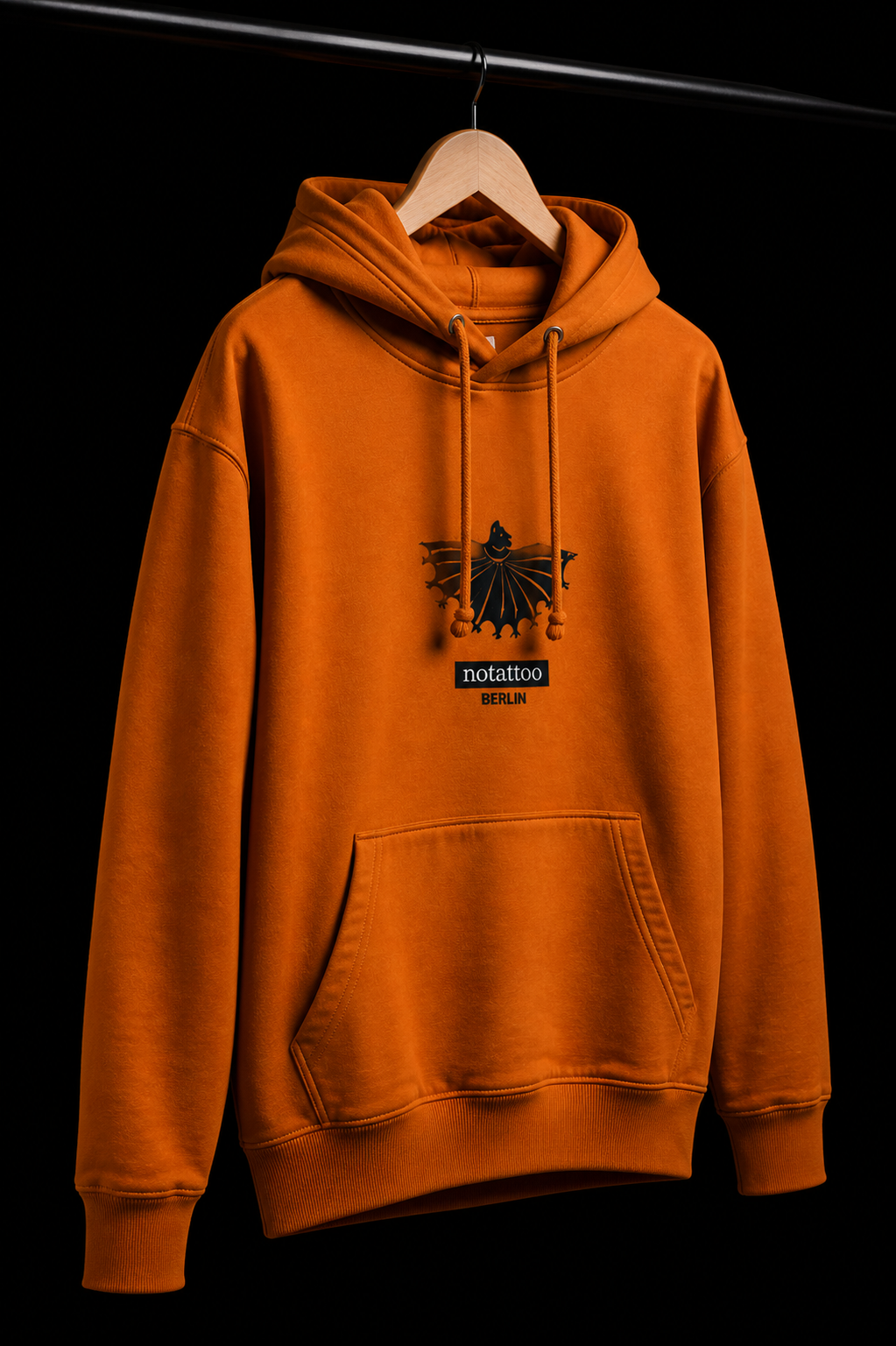
Made with a smooth 100% cotton face for crisp embroidery and a soft fleece-lined interior for warmth and comfort. Flat drawstrings, a front pouch pocket, and a tear-away label complete the garment's everyday design.
— Limited edition to 6
— Embroidered medieval bat
— Adobe Yellow
— Tattoo-inspired piece
— Developed in Berlin
— No restocks
• 65% ring-spun cotton, 35% polyester
• Charcoal Heather, Carbon Grey, and Oatmeal Heather are 55% ring-spun cotton, 45% polyester
• 100% cotton face
• Fabric weight: 8.5 oz./yd.² (288.2 g/m²)
• Front pouch pocket
• Matching flat drawstrings
• 3-panel hood
Disclaimer: This hoodie runs small. For the best fit, we recommend ordering one size larger than your usual size.
The Medieval Bat
This bat comes from the world of medieval bestiaries, books that brought together real animals, imagined creatures and religious ideas. The artists who made these images did not always draw from direct observation. Sometimes they worked from written descriptions, old copies or stories passed from one person to another.
That may explain the strange appearance of this bat. Its wings are open in a wide, almost symmetrical shape, while the face looks furry, human and slightly unreal. The animal is clearly recognisable, but its body seems partly observed and partly invented.
We do not know whether the artist had ever seen a bat closely. This uncertainty makes the image more interesting. It shows not only the animal, but also how people tried to understand something unfamiliar. As a tattoo, the bat keeps this mixture of reality, imagination and mystery. tattooJOURNALhere
