Bacchus and a Divine March
La Jeunesse de Bacchus is something else entirely
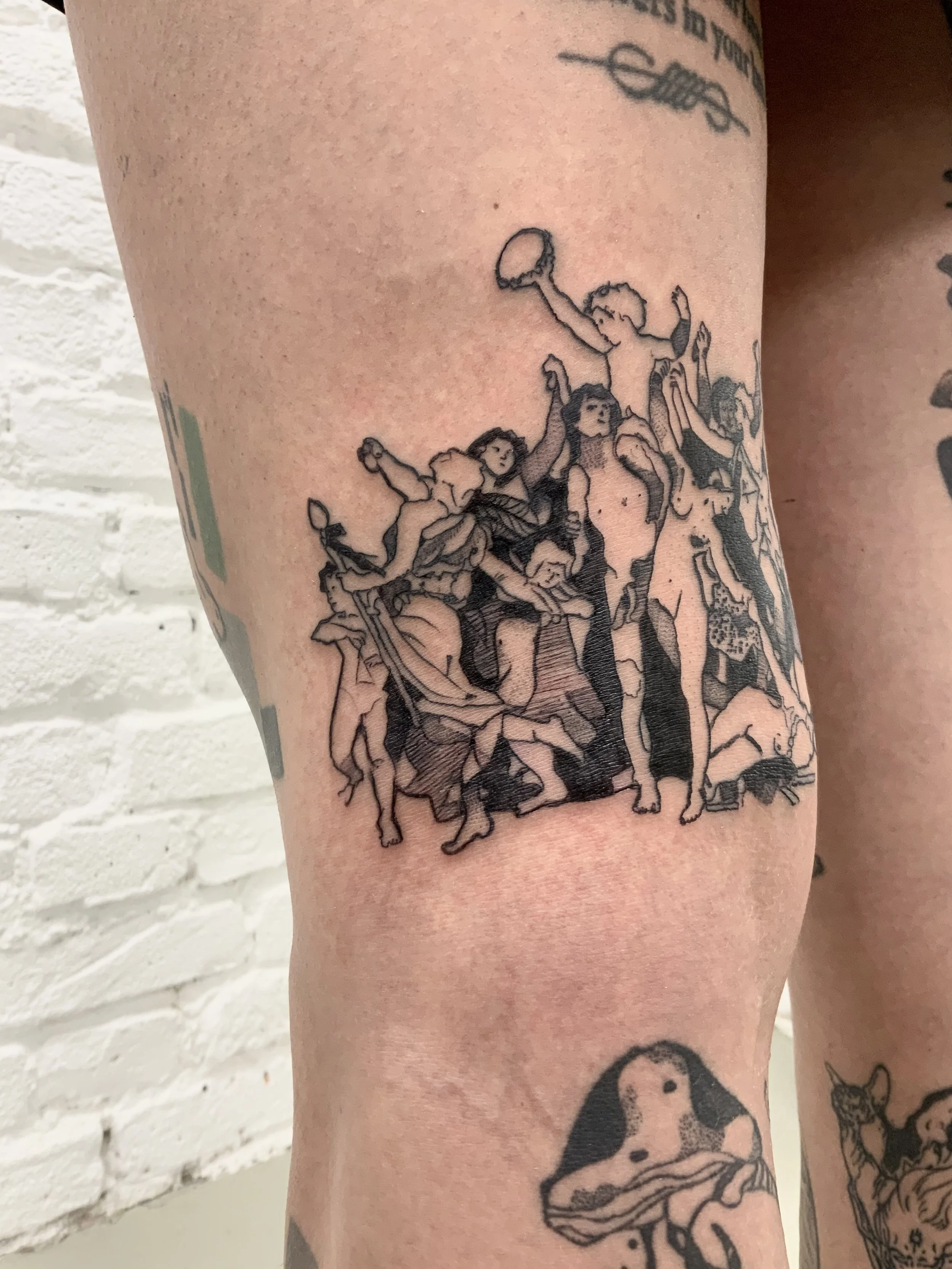
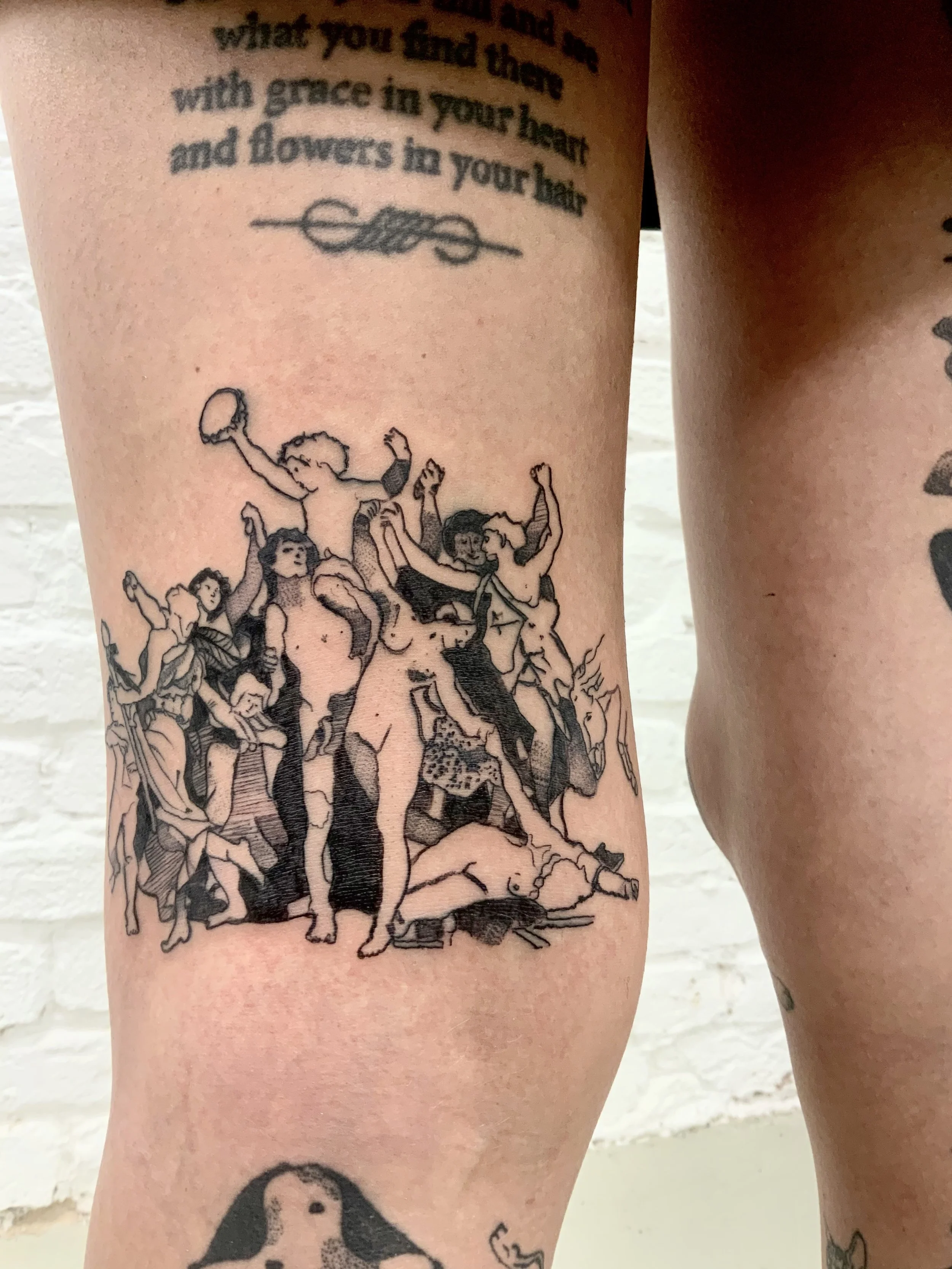
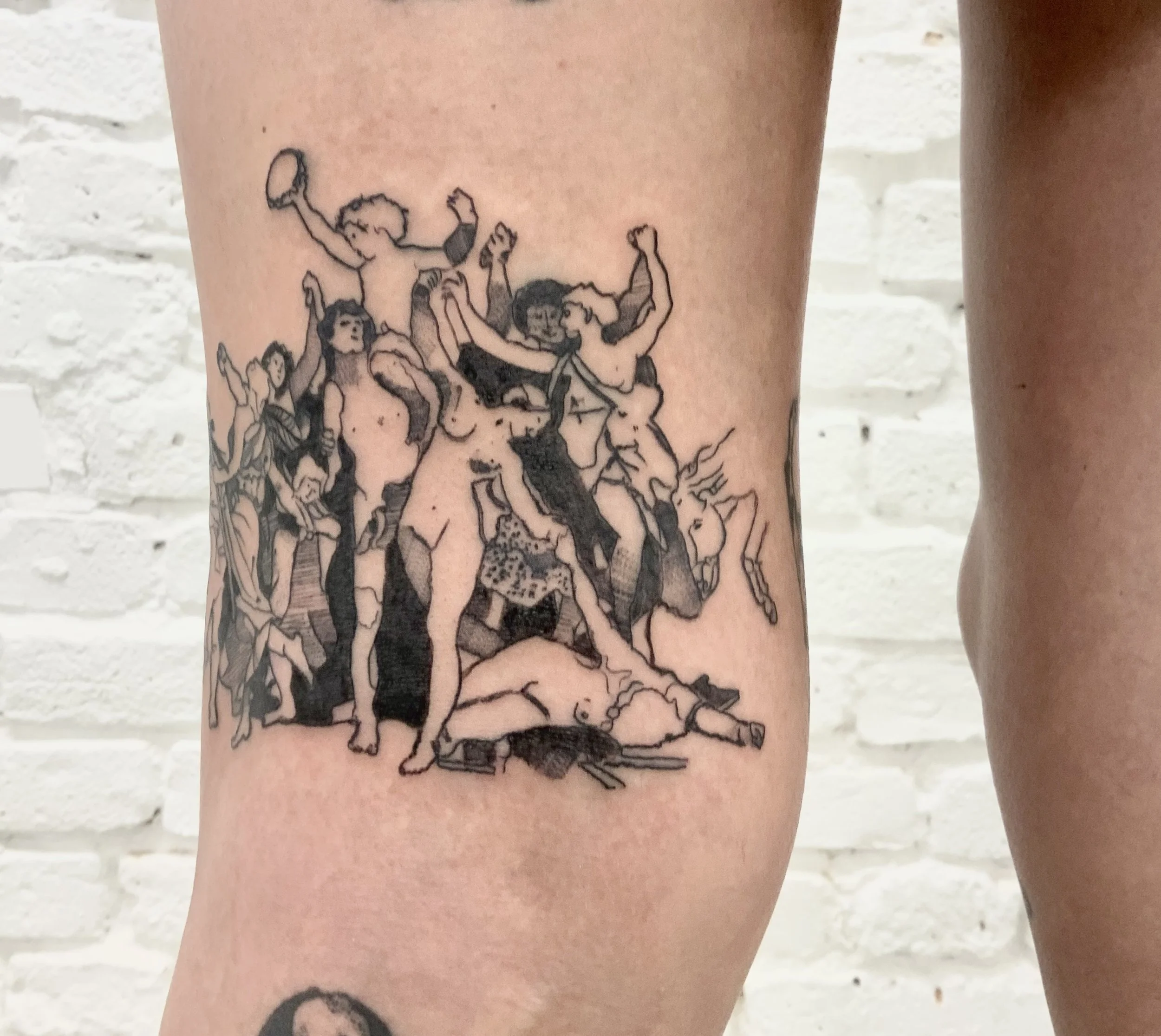
This tattoo was made at Visions of Ecstasy for @etions_formidables, the owner of the studio where I first began tattooing.
It was right at the beginning of my time there — a period defined by excitement, uncertainty, mistakes, learning, and the constant feeling of stepping into unfamiliar territory. Looking back, it feels appropriate that one of the first larger pieces I made there was based on La Jeunesse de Bacchus by William-Adolphe Bouguereau.
Her choice felt immediately right.
The painting has accompanied me for years. Not because of its technical perfection, although it is difficult to ignore Bouguereau's extraordinary control as a painter. What continues to draw me back is the atmosphere of the image itself. It is a celebration, but not a chaotic one. A procession, but not a military march. The figures move together, carried by music, ritual, intoxication, and desire, yet the painting never loses its sense of balance.
Ancient celebrations, ecstatic rites, mythological abandon — these themes have always interested me. Not because they offer an escape from reality, but because they reveal another way of being within it.
Bacchus occupies a strange position within classical mythology. He is the god of wine, pleasure, intoxication, theatre, and festivity, but beneath those associations lies something more complex. He represents transformation. The temporary suspension of ordinary structures. The moment when rules become flexible, identities become fluid, and people allow themselves to cross boundaries that usually remain fixed.
That idea appears repeatedly throughout art history because it remains deeply human.
Every culture develops rituals that create distance from ordinary life. Festivals. Gatherings. Music. Processions. Celebrations. Moments where people step outside routine and enter a different rhythm. The figures in Bouguereau's painting seem suspended inside precisely that condition. They are moving somewhere, but the destination feels less important than the act of moving together.
What interests me most about La Jeunesse de Bacchus is that it understands devotion as movement rather than belief.
The procession itself becomes a form of faith.
Bodies moving through space.
Music creating temporary communities.
People surrendering themselves to a shared experience without needing to explain it.
Perhaps that is why the image still feels contemporary despite its mythological subject. The painting describes something that continues to exist. We still gather. We still celebrate. We still lose ourselves in crowds, concerts, festivals, clubs, and collective experiences. The forms change, but the impulse remains remarkably similar.
When translating the painting into a tattoo, the challenge was never to reproduce the entire composition. The original work contains dozens of figures, layers of movement, and an enormous amount of visual information. The goal was to preserve the energy of the procession rather than its exact structure.
We placed the tattoo on one of the most demanding areas of the body: the back of the knee.
I had heard the warnings.
Everyone talks about the pain there.
They were not exaggerating.
In a strange way, that intensity felt appropriate. The procession itself demands movement. The tattoo demanded endurance. Both required a certain form of surrender.
What I continue to admire about Bacchus is that he reminds us that life cannot be reduced entirely to discipline, productivity, or control. There must also be room for celebration, uncertainty, pleasure, excess, and collective joy. Not permanently. Not without limits. But enough to remind us that another rhythm exists.
You do not need to know the mythology to understand the image.
You only need to look.
The procession is still moving.
The music has not stopped.
And this divine march — wild, radiant, and unfinished — continues forward.
A march I know I will never stop walking.
Text by noTATTOO Berlin.
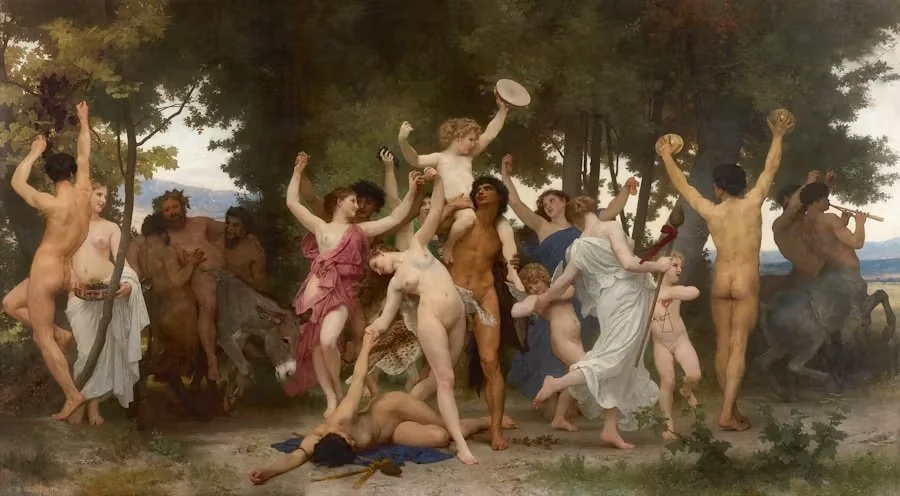
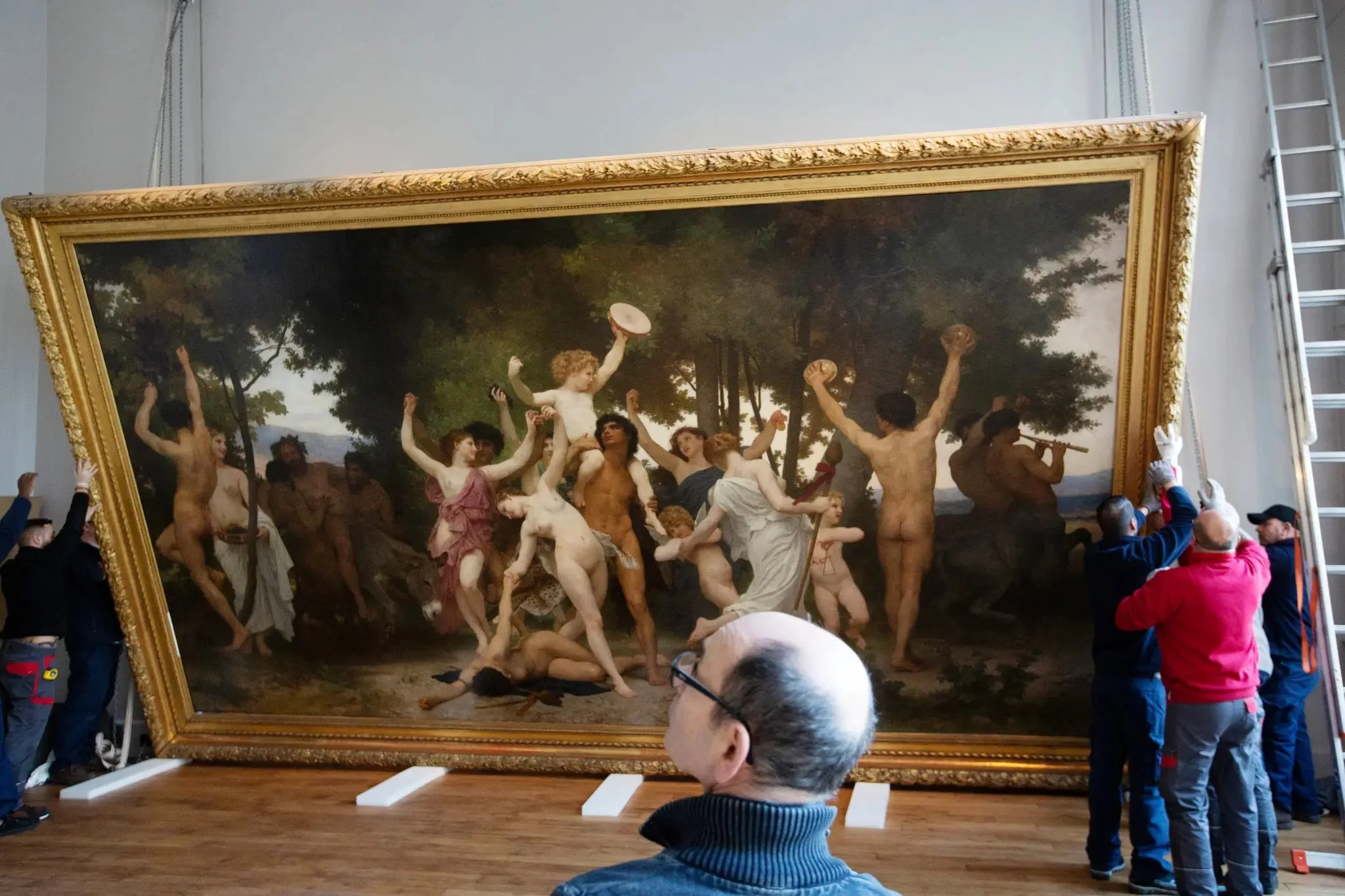
La Jeunesse de Bacchus
is a procession that never really stops.
Bouguereau’s technique is flawless. Every muscle, every strand of hair, every bit of fabric — it’s all so carefully done you almost forget it's paint. You can feel the hours in each figure. And yet, the painting doesn’t feel frozen. It doesn’t show off. It moves. It breathes. Somehow, underneath all that discipline, something wild manages to break through. Like the canvas couldn’t fully contain it.
There’s a kind of freedom leaking through the edges. Not the loud kind. Not chaos. Just a quiet energy that keeps pushing forward. Like it knows something you don’t. Like it doesn’t want to be looked at — it wants to pull you in and carry you with it.
But for years, no one saw it.
Too big. Too theatrical. Too much for the walls and tastes of its time. So they rolled it up. Put it away. Let it fade into storage. Like it was too alive to deal with.
But a painting like this doesn’t disappear. Not really. It waits. It waits for the right eyes, the right moment, the right world to see it again. And when it came back, it didn’t need to shout. It just stood there, exactly as it always was — with the quiet confidence of something that never lost its power. Just its spotlight.
References:
Official Musée d'Orsay Page (where the painting is currently housed):
https://www.musee-orsay.fr/en/artworks/jeunesse-de-bacchus-153183
(Includes high-resolution images, provenance, and museum notes.)Google Arts & Culture - La Jeunesse de Bacchus:
https://artsandculture.google.com/asset/la-jeunesse-de-bacchus-william-adolphe-bouguereau/2wFWVTuVxOm89A
(Explore in ultra-high detail and zoom in on the figures and brushwork.)
Context, Symbolism, and Interpretation
Analysis by The Art Story Foundation – Bouguereau’s style and mythological themes:
https://www.theartstory.org/artist/bouguereau-william-adolphe/"The Return of Bouguereau" – Smithsonian Magazine:
https://www.smithsonianmag.com/arts-culture/the-return-of-bouguereau-132713095/
(A look at Bouguereau’s fall from critical favor and resurgence.)
The Myth of Bacchus/Dionysus
Perseus Digital Library – Bacchus/Dionysus in Greek Literature:
http://www.perseus.tufts.edu/hopper/searchresults?q=dionysus
(Explore original ancient texts featuring Bacchus/Dionysus.)Dionysus: Archetype of Ecstasy and Liberation (Encyclopedia Britannica):
https://www.britannica.com/topic/Dionysus
Bouguereau’s Artistic Legacy
Art Renewal Center – William-Adolphe Bouguereau Gallery:
https://www.artrenewal.org/artists/william-adolphe-bouguereau/6
(Extensive archive of his works in high resolution.)Bouguereau and the Academic Tradition (Metropolitan Museum of Art essay):
https://www.metmuseum.org/toah/hd/adac/hd_adac.htm
