After Cana or The World Creation, 2018
After Cana (“The Great Arrival / The Creation of the World”), 2018
Carvão sobre papel, 240 × 300 cm (composto por dezasseis folhas)
Coleção: Enter Foundation
PT
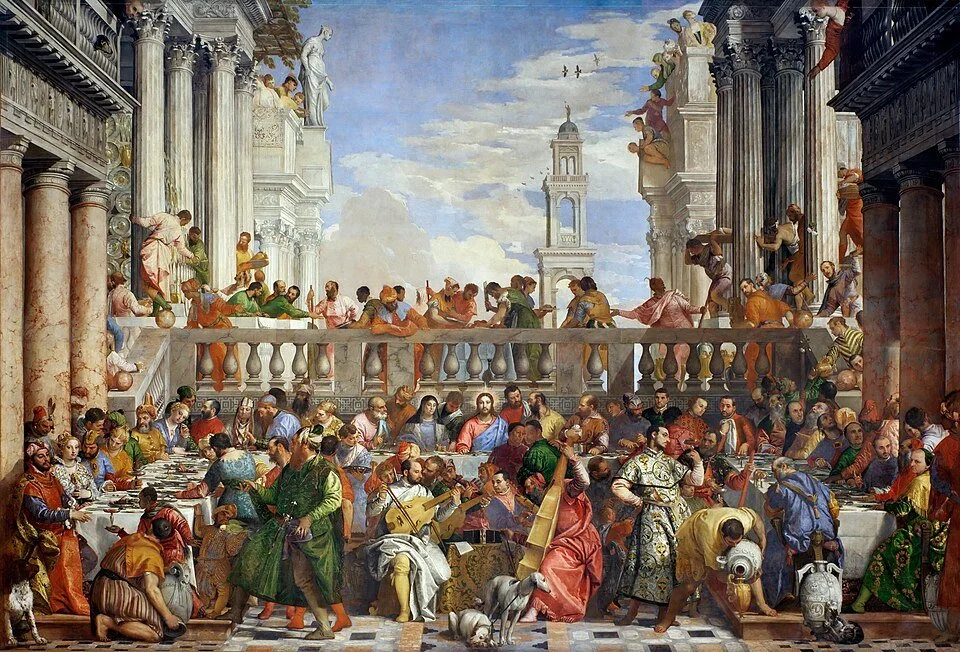
O desenho de Jorge Da Cruz pode ser lido como um silencioso ato de sabotagem dirigido ao Casamento em Caná de Paolo Veronese. A pintura de 1563 de Veronese apresenta-se como um espetáculo de abundância renascentista — arquitetura em patamares, talheres dourados, convidados vestidos de seda e, acima de tudo, o milagre que transforma a humilde água em vinho nobre. Da Cruz preserva a longa mesa do banquete e a multidão cosmopolita, mas esvazia a cena da sua exultação. Aqui, o milagre inverte-se: a água sobe em vez de recuar, irrompendo pelo canto inferior esquerdo, espalhando-se pelo pavimento de tesselas e tocando as botas dos músicos. Alguns convivas retesam-se; a maioria continua a erguer os copos, determinada a permanecer dentro da ilusão da festa.
A própria superfície participa no drama. Dezasseis folhas individuais são reunidas numa única imagem, formando uma grelha subtil que fratura a composição como o craquelé de uma cerâmica envelhecida. Estas emendas expõem a construção da obra, sugerindo quão facilmente a cena — e, de facto, qualquer ordem social — pode começar a desfazer-se. No centro superior, uma inesperada faixa de papel em branco abre-se para o céu: uma pausa pálida onde três pequenas aves descrevem círculos sobre telhados distantes. Esse vazio ressoa quase com mais força do que o carvão denso abaixo — um fôlego suspenso antes de a cheia concluir a sua ascensão.
Os negros arroxeados e os cinzentos calcários do carvão substituem os opulentos óleos de Veronese. O pó assenta como cinza, suavizando as figuras até que os rostos parecem pairar entre presença e apagamento. Um brilho detém-se no bordo de um cálice ou na dobra de uma manga branca, mas vacila, instável, como uma luz de emergência durante uma falha de energia. Colunas traçadas em vigorosos veios verticais continuam a erguer-se em ambos os lados, mas até esses sentinelas de pedra parecem porosos, marcados pela humidade.
O que emerge é uma alegoria da abundância precária. O banquete parece faustoso, mas os seus alicerces — arquitetónicos, ecológicos, espirituais — já começam a ceder. Da Cruz não se limita a ilustrar a ansiedade climática, embora a água invasora torne essa leitura difícil de evitar. Mais do que isso, investiga a fissura psicológica entre celebração e pressentimento: a nossa capacidade de rejubilar enquanto o soalho range, de brindar à prosperidade quando a cheia já nos chega aos tornozelos. After Cana convida o espectador a demorar-se nesse intervalo inquieto — entre ritual e rutura — e a perguntar durante quanto tempo uma cultura consegue sustentar a festa quando os próprios elementos da vida, a água e a luz, começam a escapar ao controlo.
Berna Valada, 2021
After Cana (“The Great Arrival / The Creation of the World”), 2018
Charcoal on paper, 240 × 300 cm (composed of sixteen sheets)
Collection: Enter Foundation
EN
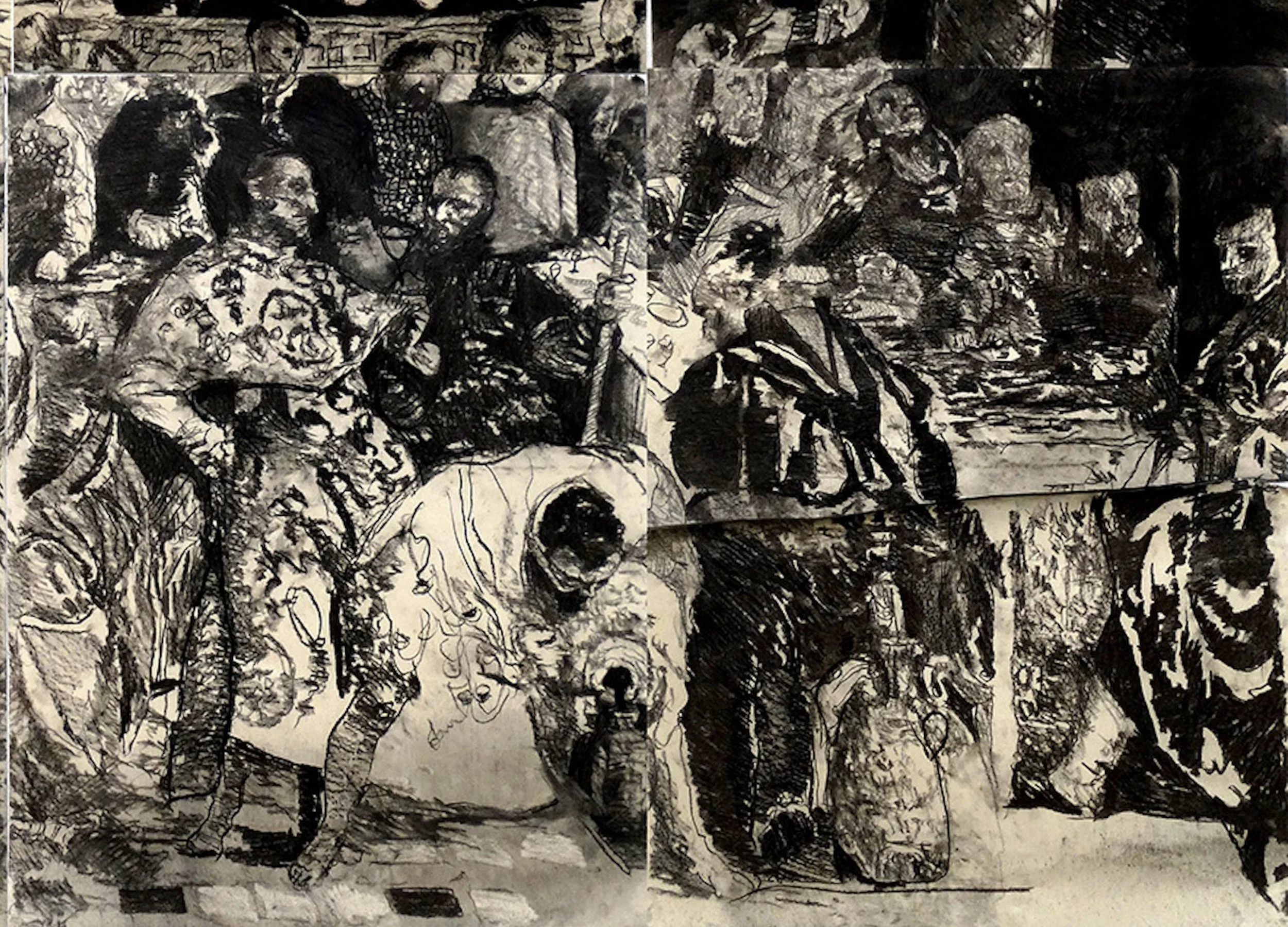
Jorge Da Cruz’s drawing may be read as a silent act of sabotage directed at Paolo Veronese’s The Wedding at Cana. Veronese’s 1563 painting unfolds as a spectacle of Renaissance abundance—tiered architecture, gilded tableware, guests clothed in silk, and, above all, the miracle that transforms humble water into noble wine. Da Cruz preserves the long banquet table and the cosmopolitan crowd, yet drains the scene of its jubilation. Here, the miracle is reversed: water rises rather than recedes, surging in from the lower left corner, spreading across the tessellated floor and lapping at the musicians’ boots. A few guests tense visibly; most continue to raise their glasses, determined to remain within the illusion of the feast.
The surface itself participates in the drama. Sixteen individual sheets are assembled into a single image, forming a subtle grid that fractures the composition like the craquelure of an aged ceramic. These seams lay bare the work’s construction, suggesting how easily the scene—and, indeed, any social order—might begin to unravel. At the upper centre, an unexpected band of blank paper opens onto the sky: a pale pause in which three tiny birds circle above distant rooftops. This emptiness resonates almost more forcefully than the dense charcoal below—a suspended breath before the flood completes its ascent.
The purplish blacks and chalky greys of charcoal replace Veronese’s opulent oils. Dust settles like ash, softening the figures until their faces seem to hover between presence and erasure. A glimmer catches on the rim of a chalice or the fold of a white sleeve, yet it flickers uncertainly, like emergency lighting during a power failure. Columns, drawn in emphatic vertical strokes, still rise on either side, but even these stone sentinels appear porous, marked by damp.
What emerges is an allegory of precarious abundance. The banquet seems lavish, yet its foundations—architectural, ecological, spiritual—are already beginning to yield. Da Cruz does not simply illustrate climate anxiety, although the encroaching water makes that reading difficult to avoid. Rather, he investigates the psychological fracture between celebration and foreboding: our capacity to rejoice while the floorboards creak, to toast prosperity while the flood is already at our ankles. After Cana invites the viewer to linger within this unsettled interval—between ritual and rupture—and to ask how long any culture can sustain the feast when the very elements of life, water and light, begin to slip beyond control.
Berna Valada, 2021
