Bethanien, or Berlin’s Cultural Machine
DE
Interview by Joana Violante
Graduated in Communication Sciences and with a Master’s in Radio Journalism from the University of Beira Interior, she has lived and worked in Berlin since November 2013.
If the city of Berlin breathes art and culture, then Bethanien is undoubtedly part of its respiratory system. These "lungs of the city," where living off art is possible, resemble a miniature Berlin: rich in history, home to various nationalities, and filled with art and culture across disciplines — even down to its graffiti-covered walls. Among this machine, many Portuguese artists have found a place.
The Institution – A Centuries-Old History
The history of Bethanien dates back to 1847, when King Friedrich Wilhelm IV of Prussia ordered the construction of a hospital designed by Theodor Stein. In addition to a 500-bed hospital, the facility included an institute for training nurses and doctors, and an orphanage.
Once completed, the hospital remained active for more than a century. By the 1960s, as a result of World War II and the Cold War, it began to face financial difficulties and was deemed unsustainable. In 1969, it was slated for demolition.
Protests followed, and the building was granted protected status. Still, closure became inevitable, and in 1970 it was sold to the German government for 10.5 million Deutsche Marks.
Then came the great battle for survival. To prevent demolition and the construction of public housing on the site, the building was occupied by locals. Their determination prevailed: the building was preserved, and an agreement was reached with the government to use it legally for a youth residential project.
The Berlin-based band Ton Steine Scherben immortalized the events in the song “Rauch Haus Song.”
Bethanien reopened its doors in 1973. Since then, it has provided space for cultural and artistic institutions. In addition to the Kunstraum Kreuzberg/Bethanien, it houses the BBK Berlin Printing Studio, art studios, exhibition spaces, theater and dance venues, the Kreuzberg School of Music, and more.
Thus, a building was reborn — a cultural hub that became a vital part of Berlin's creative engine.
Bethanien and Gulbenkian – A Successful Partnership
Artist development and engagement with art is the core mission of this institution, located on Kottbusser Damm, which welcomes dozens of new resident artists each year for 6 to 12-month stays.
This international residency program serves as a platform for artists from around the world to develop and implement a project, as well as to establish themselves in Berlin’s art scene.
Portugal is one of the countries that annually “sends” an artist to this program, through a protocol with the Calouste Gulbenkian Foundation (FCG). The partnership between the two institutions is now in its 15th year.
Luís Gil, head of Internationalization Support and Distribution Process Manager for the Visual Arts sector at FCG, explained to Berlinda how it began:
“The partnership started with the now-defunct Fine Arts department.
Every year we received multiple applications for Bethanien from emerging artists.”
“So we moved forward with a partnership proposal.”
Since then, the FCG receives around 50 to 60 applications each year. Only one grant is awarded, determined by a jury made up of various artistic entities through a competitive selection process.
One of the essential criteria is the:
“Presentation of an original project that aligns with the current artistic context,” says Luís Gil.
The selected artist is then given the opportunity to spend a year in Berlin. Of the 14 grants awarded so far, Luís Gil affirms that the feedback is always:
“Extremely positive, as reflected in the artists’ final reports.
They consistently highlight the renewal of ideas, cultural exchange, and of course, the overall experience.”
Bethanien as an Official Studio Space
In addition to hosting grantees, Bethanien also rents out studios to artists. Finding a spot isn’t easy — but it’s not impossible. Competition is tough and creativity is high, so you have to show commitment and achievement.
This is not a place for playing at being an artist — here, art is a profession.
Sérgio Fernandes and Jorge da Cruz, from theater and visual arts respectively, joined Bethanien around four years ago and have had permanent studios there ever since.
“Bethanien was undergoing structural changes,” explained Jorge da Cruz.
“At the time, all resident artists in the basement were moved to a new building on Kottbusser Straße, with better living and working conditions.”
Bethanien opened applications for the vacant studios. The two Portuguese artists applied and were accepted — among the first to enter this “new phase.”
According to Sérgio, the main idea at the time was to:
“Balance artistic diversity”
and
“Open up the space to more performing arts professionals.”
New companies joined, including the Mimo International Center, the Institute of Theater, Sérgio himself, and other theater-related artists — giving rise to the Performance of Bethanien.
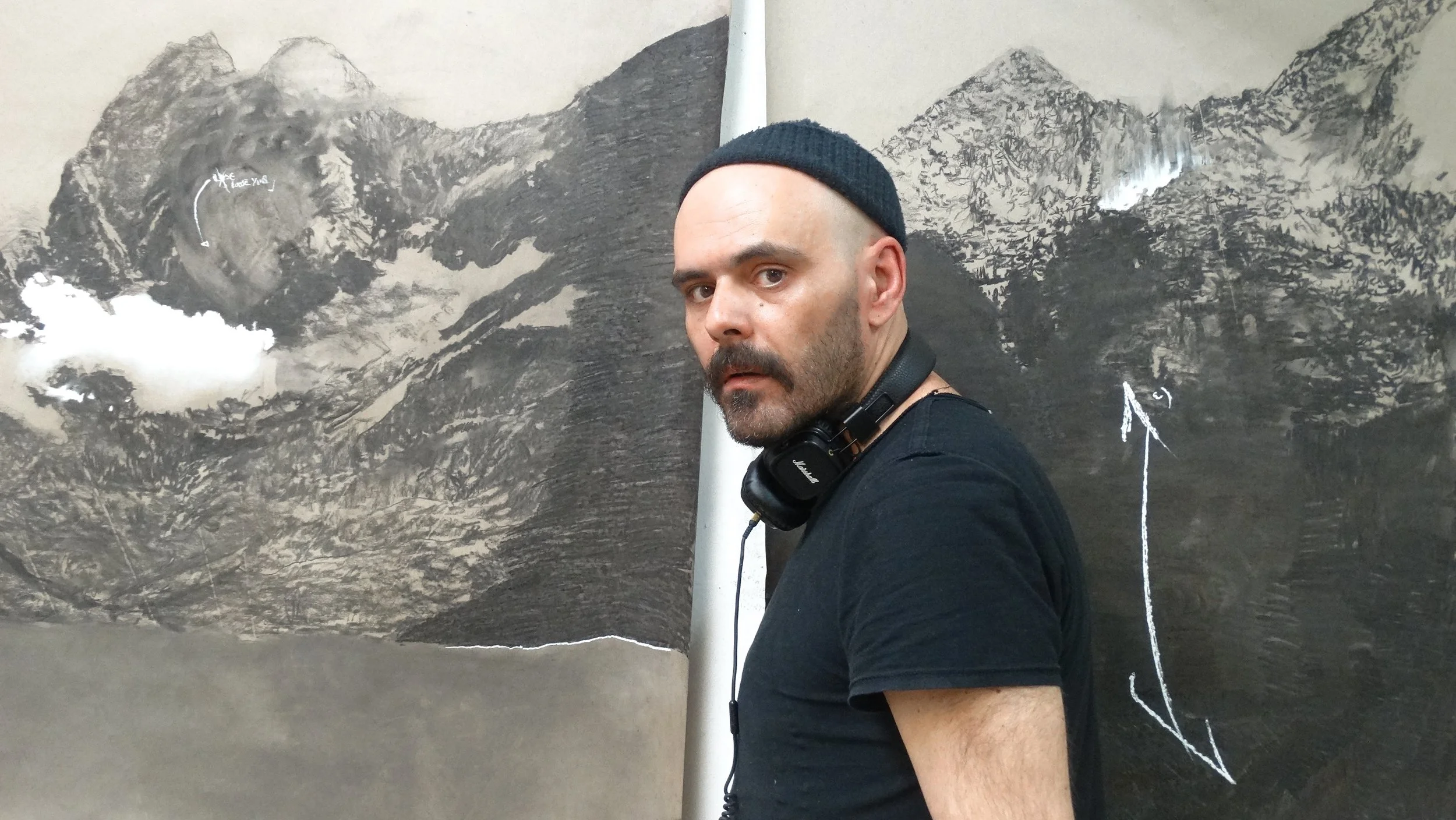
Jorge da Cruz – A Visual Artist With One Foot in Lisbon, the Other in Berlin
Jorge da Cruz moved to Germany in 2006. He had previously spent a few years in Kassel, where he held several exhibitions. About four years later, he moved to Berlin.
There, he began carving out a path toward making a living from art — something he knew wasn’t possible in Portugal:
“Since coming here, I’ve started to exhibit and sell.
I still don’t live off painting entirely —
but now I can say ‘I don’t live off painting yet’,
which would have been unthinkable in Portugal.”
With a degree in Painting and Drawing from Ar.Co – Center for Arts & Communication in Lisbon, he observes that:
“Out of either illusion or naivety, painting isn’t direct enough and doesn’t reach people in a powerful way.
People are more resistant, less willing to surrender or be moved.”
To address that, Jorge complements his paintings with videos — “non-technical,” “lacking cinematic expertise” — essentially creating:
“Paintings that move.”
“It’s almost an analogy for what’s missing — or nearly missing — in painting.
For me, painting has to move, it has to step off the canvas and touch people.”
Over time, his studio became more than just a workspace — it became a kind of “second home,” shared with five other friends, all artists.
“It’s almost like a family that gathers there every day —
a place where we can go and feel safe, where art is in the air.”
It’s the right environment for creative growth, says Jorge, as it offers:
“A balance between solitude and community.”
Although his work is based in Berlin — and he can “almost” live from his art — Jorge does not consider himself a “typical emigrant.”
He has one foot in Lisbon and the other in Berlin.
He draws life from Lisbon, which he visits often,
but his work is in Berlin.
One day,
“I’d like to live in Portugal again. But for now, it’s just for vacations.”
Text: Joana Violante
Editing: Inês Thomas Almeida
PT
Entrevista por Joana Violante
Licenciada em Ciências da Comunicação e Mestre em Jornalismo de Rádio pela Universidade da Beira Interior, vive e trabalha em Berlim desde novembro de 2013.
Se a cidade de Berlim respira arte e cultura, o Bethanien é sem dúvida parte do seu sistema respiratório. Os pulmões da cidade, onde viver de arte é possível, assemelham-se a uma Berlim em ponto pequeno: carregados de história, várias nacionalidades, arte e cultura dos mais variados campos – e até paredes com graffitis. No meio desta máquina, há muitos portugueses.
A Instituição – uma história secular
A história do Bethanien remonta a 1847, quando o Rei da Prússia, Friedrich Wilhelm IV, mandou edificar um hospital desenhado por Theodor Stein. Para além do hospital com cerca de 500 camas, foi construído um instituto para a formação de enfermeiros e médicos e um orfanato.
Obra feita, o hospital manteve-se ativo durante mais de um século. A partir dos anos 60, fruto das consequências da Segunda Guerra Mundial e da Guerra Fria, o hospital começa a ter algumas dificuldades financeiras, prevendo-se já a impossibilidade de o manter. Tanto que, em 1969, recebe uma ordem de demolição.
Os protestos começam e o Bethanien consegue um estatuto de edifício protegido. No entanto, o fecho torna-se inevitável e acaba por acontecer um ano mais tarde, em 1970, altura em que é vendido ao Estado Alemão por 10,5 milhões de Marcos.
Começa a grande batalha de sobrevivência. Para evitar a demolição e a construção de habitações sociais no seu lugar, o edifício começa a ser ocupado por populares. A sua força fala mais alto: conseguem manter o edifício erguido e acordam com o Estado o seu uso legal para um projeto residencial de jovens.
A banda berlinense Ton Steine Scherben imortaliza estes momentos na música "Rauch Haus Song".
O Bethanien abre novamente as suas portas em 1973. Desde então, tem oferecido espaço para instituições culturais e artísticas. Para além do Kunstraum Kreuzberg/Bethanien, existe ainda o BBK Berlin Printing Studio, estúdios, espaços para exposições, teatro e dança, a Escola de Música de Kreuzberg, entre outros.
Renasce assim um prédio, uma entidade, que se transforma no pulmão cultural de Berlim.
Bethanien e Gulbenkian – uma relação de sucesso
A formação de artistas e a vivência da arte é o papel fundamental desta instituição no Kottbusser Damm, que todos os anos recebe dezenas de novos artistas em residência, durante 6 a 12 meses.
Este programa de intercâmbio é uma plataforma para artistas de todo o mundo e dá a oportunidade de desenvolver e implementar um projeto, bem como consolidar a sua posição no cenário berlinense.
Portugal é um dos países que todos os anos “envia” um artista para este programa, através do protocolo existente com a Fundação Calouste Gulbenkian (FCG). A parceria entre as duas instituições fará agora 15 anos.
Luís Gil, responsável pelo Apoio à Internacionalização e Gestor de Processos de Ação Distributiva de Artes Visuais da FCG, explicou à Berlinda como tudo começou:
“A parceria teve início com o extinto serviço de Belas Artes. Todos os anos, apareciam várias candidaturas para o Bethanien, para futuros artistas”, e por isso, decidiram avançar com a proposta de parceria.
Desde então, todos os anos a FCG recebe cerca de 50 a 60 candidaturas para a instituição alemã. Só é concedida uma bolsa, decidida por um júri de várias entidades artísticas através de um extenso processo de seleção.
Um dos critérios essenciais para obtenção da bolsa é a:
“Apresentação de um projeto original, que deve ir de encontro às necessidades artísticas do momento”, diz Luís Gil.
Escolhido o feliz contemplado, o vencedor tem a oportunidade de passar um ano em Berlim. Em todas as 14 bolsas já atribuídas, Luís Gil garante que o feedback é sempre:
“Extremamente positivo, como mostram [os artistas] no relatório final. Os candidatos realçam a renovação de ideias, o intercâmbio cultural e, claro, a experiência.”
O Bethanien como escritório oficial
Além de acolher bolseiros, o Bethanien também coloca ateliers à disposição de artistas que os queiram alugar. Encontrar uma vaga não é fácil, mas também não é impossível. A concorrência e a criatividade dos vários interessados é forte, por isso é preciso mostrar trabalho e uma certa realização.
Aqui não se brinca aos artistas – vive-se de arte e da sua profissionalização.
Sérgio Fernandes e Jorge da Cruz, respectivamente do teatro e da pintura, entraram para o Bethanien há cerca de quatro anos, e desde então ali têm o seu atelier permanente.
“O Bethanien estava a passar por uma alteração estrutural”, explicou Jorge da Cruz.
“Nessa altura todos os artistas que estavam em residência na cave passaram para um novo edifício na Kottbusser Straße, com mais condições de habitabilidade”.
O Bethanien decidiu “abrir concurso aos espaços e aos ateliers que ficaram livres”. Os dois artistas portugueses candidataram-se e foram aceites, sendo dos primeiros a entrar para esta “nova fase”.
Por esta altura, conta Sérgio, uma das ideias principais era:
“Equilibrar a variedade artística”
e
“Abrir este espaço a pessoas mais viradas às artes de palco”.
Entraram várias companhias, o Mimo Internacional Centro, o Instituto de Teatro, Sérgio e várias outras pessoas ligadas ao teatro. Abriu-se assim o Performance of Bethanien.
Jorge da Cruz – o artista plástico com um pé em Lisboa e outro em Berlim
Jorge da Cruz veio para a Alemanha em 2006. Antes tinha estado em Kassel durante alguns anos, onde realizou várias exposições. Cerca de quatro anos mais tarde, decidiu mudar-se para Berlim.
Aqui começou a trilhar o seu caminho para viver da Arte – algo que sabia ser impossível em Portugal:
“Desde que vim para cá comecei a expor e a vender. Ainda não vivo da pintura,
mas hoje posso dizer ‘ainda não vivo da pintura’ – algo impensável em Portugal.”
Com formação em Pintura e Desenho pela Ar.Co – Centro de Artes & Comunicação de Lisboa, considera que:
“Por ilusão ou estupidez, a pintura não é suficientemente direta
e não entra na vida das pessoas de uma forma forte.
As pessoas estão muito mais resistentes, menos disponíveis para se deixar entregar ou comover.”
Para remediar a situação, Jorge complementa as suas pinturas com vídeos, “nada técnicos” e sem “conhecimentos cinematográficos”, criando:
“Pinturas que se movem.”
“É quase como uma analogia daquilo que falta, ou que quase falta na pintura.
Para mim, a pintura tem que se mexer, tem que sair da tela e tocar nas pessoas.”
Com o tempo, o atelier deixou de ser apenas um local de trabalho e tornou-se uma espécie de “segunda casa”, partilhada com mais cinco amigos – todos artistas.
“É quase uma família que se junta ali todos os dias,
um sítio onde nós podemos ir com segurança e onde se respira arte.”
Este é o ambiente certo para o desenvolvimento artístico, diz Jorge, pois consegue ter ao mesmo tempo:
“Uma certa dose de isolamento e os artistas e amigos ao redor.”
Apesar do trabalho de Jorge ser desenvolvido em Berlim – e aqui poder quase viver da arte e da pintura –, o artista português não se considera um “emigrante típico”.
Tem um pé lá, em Lisboa, e o outro cá, em Berlim.
Vive de Lisboa, onde vai com frequência, mas trabalha em Berlim.
Um dia “gostava de voltar a viver em Portugal. Mas por enquanto é só férias.”
Texto: Joana Violante
Revisão: Inês Thomas Almeida