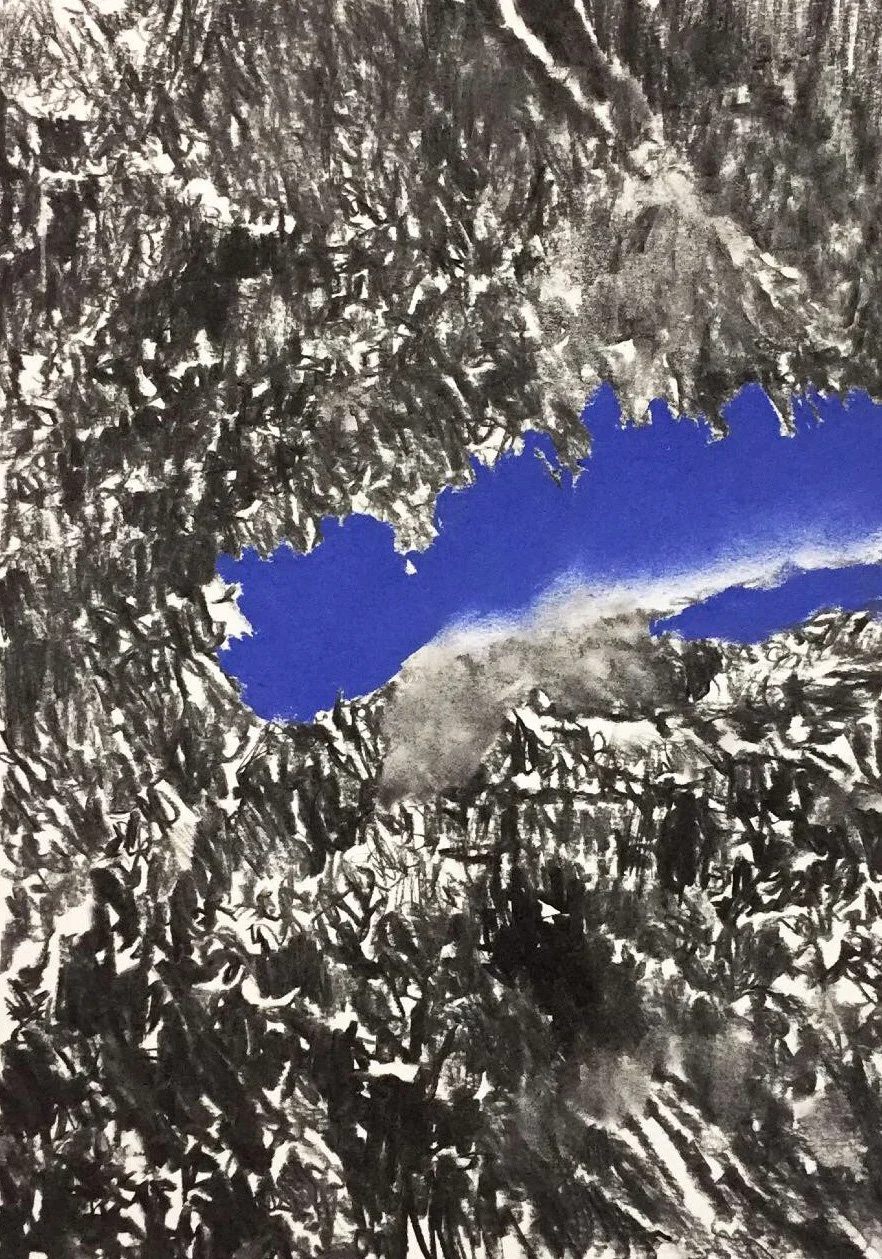
•one step before happiness - l charcoal on paper | 160x120cm l © k37 studio Berlin 2019
Jorge da Cruz
One Step Before Happiness, 2024
Charcoal on paper
Series of works in various sizes and compositions
Text by Berna Valada
One Step Before Happiness is a series of charcoal drawings about mountains, thresholds, and the fragile moment before change.
For centuries, mountains have carried symbolic weight. They have been seen as sacred places, points of contact between earth and sky, places of endurance, solitude, danger, and revelation. In this series, that meaning is still present, but it is no longer stable. The mountain does not appear only as something to revere. It also becomes something to cross, to measure, to conquer, or to survive.
Jorge da Cruz approaches the mountain not simply as landscape, but as a form loaded with tension. The series moves through different scales and compositions. Some drawings open into distance, atmosphere, and horizon. Others bring the viewer close to surface, cracks, shadows, grain, and pressure. What first appears monumental can suddenly become intimate. What looks like landscape can become matter.
This shift is central to the work. The mountain is never only one thing. It is image, obstacle, memory, surface, and symbol. It can suggest transcendence, but also exhaustion. It can carry beauty, but also the marks of human presence.
If figures appear, they do not seem to climb toward spiritual communion. They climb through restlessness, ambition, or necessity. The mountain becomes a goal, a challenge, a measure of progress. The land responds quietly: trails repeat, surfaces erode, forms lose their untouched distance.
The drawings do not announce this directly. They let the tension appear slowly. They show how easily reverence can become conquest, and how the act of looking at nature is never innocent.
Charcoal is essential to this language. It allows the image to be built and erased at the same time. Blackness gives weight. Grey creates air. Dust settles into the paper like weather. Peaks emerge, disappear, and return as if recovered from memory rather than fully drawn into place.
There is no spectacle here. The mountains do not shine. They loom, withdraw, and hold back. The series asks for a slower gaze, one that follows small changes in tone, pressure, surface, and absence.
The title keeps the work suspended. One Step Before Happiness suggests arrival, but also hesitation. It could be the moment before relief, or the moment before collapse. The drawings remain inside that uncertainty, where something is about to change but has not yet happened.
This is not a nostalgic series. It does not ask for a return to an untouched world. Instead, it looks at the space between what mountains once meant and what they mean now: between reverence and ambition, distance and possession, beauty and responsibility.
What remains is a quiet invitation to keep looking. The mountain still holds force, even without myth. It asks for attention, humility, and care.
These drawings do not offer an answer. They hold the viewer in the interval before one is possible.