noSHberlin-Color as Presence
Every winter in Berlin, darkness becomes part of everyday life. Days become shorter, the sky turns grey for weeks at a time, and even daylight often feels filtered through a permanent layer of cloud.
The effect is difficult to quantify but easy to recognize. The city changes. The streets darken. Buildings lose contrast. People dress differently. Daily routines become heavier. For many, winter in Berlin can feel isolating. The distance between home and work grows longer than it actually is. Motivation becomes harder to maintain. The city demands a certain endurance from those who choose to stay.
And yet much of Berlin's cultural identity seems to emerge from exactly these conditions.
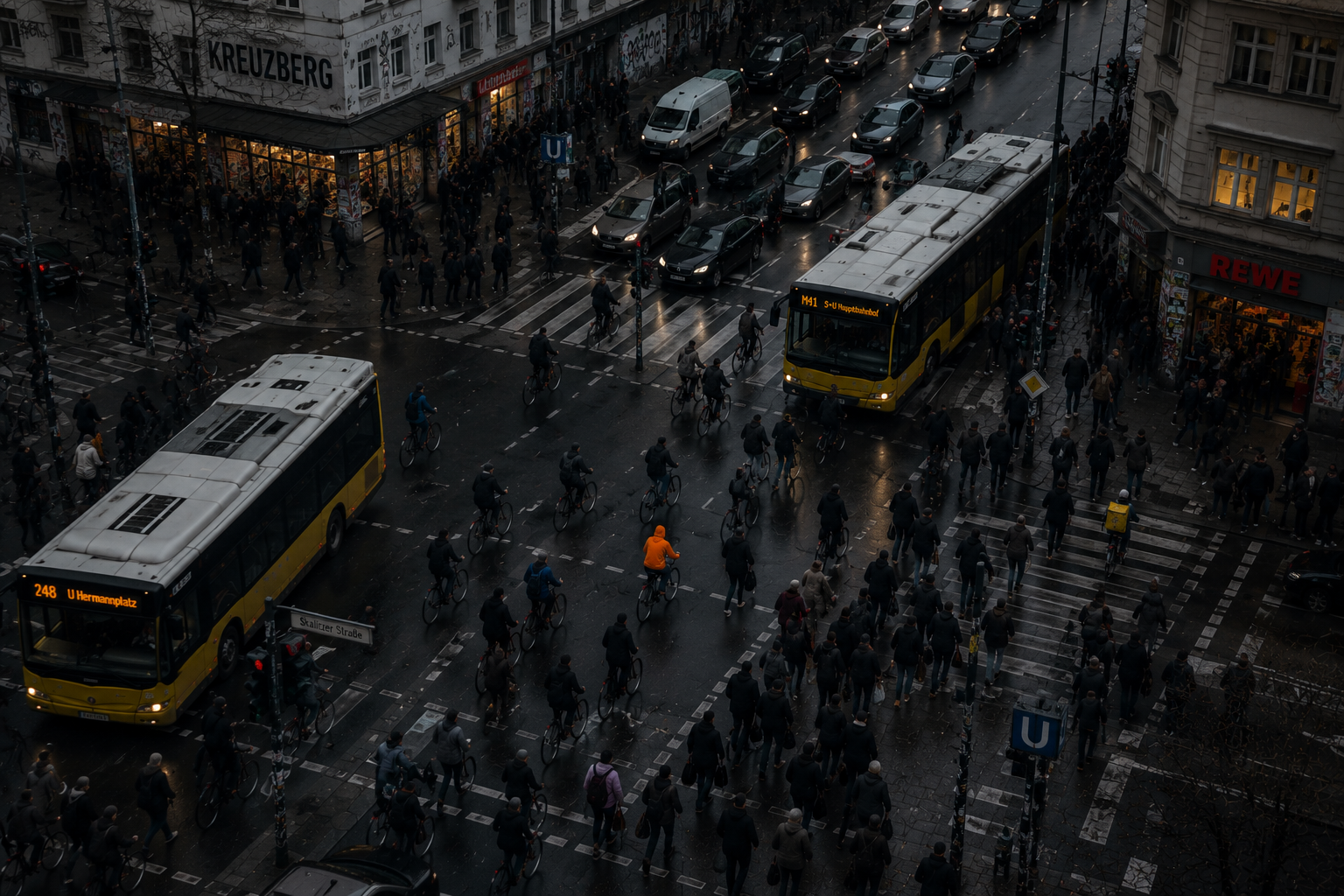
Kreuzberg, Berlin — January, 08:07

A city deprived of daylight invents other forms of life. People gather in bars, clubs, rehearsal rooms, studios, workshops, apartments, galleries, and improvised spaces. Entire social worlds emerge behind anonymous doors, inside courtyards, basements, and former industrial buildings. Berlin's nightlife is often described through music, freedom, or hedonism, but perhaps it begins somewhere more fundamental: the desire to escape darkness and find warmth in the company of others.
This is also one of the reasons why color feels different here.
In brighter places, color often becomes decoration. In Berlin, it becomes presence. Certain colors remain visible long after details disappear. Against months of grey skies, black coats, concrete, wet asphalt, and early sunsets, color acquires a different role within the landscape.
This idea gradually became important for noSHBerlin.
The project began through drawing and tattooing, but over time it became equally interested in the relationship between clothing, visibility, and the environments through which people move. The colors used in the hoodies are chosen with the same attention as the drawings themselves. Dirty Rose, Adobe Yellow, Burnt Orange, and other carefully selected tones are not there simply to attract attention. They carry atmosphere. They hold their own emotional temperature. They are colors that remain distinctive without becoming aggressive, visible without becoming loud.
In a city that spends much of the year moving through different shades of grey, color becomes part of the garment itself rather than an accessory to it. For noSHBerlin, the hoodie is never only a surface for an image or an embroidery. Its material, weight, color, and presence matter as much as the motif itself.
Perhaps this is why the project repeatedly returns to ideas of visibility, distance, movement, and the relationship between the center and the periphery. Not because these themes belong exclusively to Berlin, but because Berlin makes them difficult to ignore.
In a dark city, visibility becomes something worth thinking about.
Not visibility as spectacle.
Visibility as presence.
nOT
